Back

INTRODUCTION

Respiratory Therapists (RTs) possess a unique body of knowledge, which when shared with others, promotes the best possible outcome for patients, colleagues, students, and the public. In one way or another, all RTs provide education to those around them. However, it is important to differentiate between RTs who provide education and RT educators.

RTs Who Provide Education

The Professional Responsibilities standard in the College of Respiratory Therapists of Ontario (CRTO) Standards of Practice outlines the expectations for all Respiratory Therapists (RTs) who are Members of the CRTO.

RT’s “are responsible for educating other healthcare team members, including students regarding respiratory health and the role of RTs”. In general, this means that RTs in all practice settings have some role in providing education.

The CRTO Standards of Practice also articulates the expectation that RTs “deliver information in a manner that acknowledges individual diversity and health literacy and facilitates patients’/clients’ understanding of pertinent information”. RTs accomplish this by:

9

demonstrating best practices to students;

9

providing presentations or in-services for colleagues;

9

consulting with the health care team;

9

engaging in discussions about current RT practice with fellow RTs and students, as well as patients/clients, family members and un-paid caregivers.

This practice guideline provides information on the standard of practice related to the responsibilities of RTs when providing education. These principles apply when providing education in any setting, including:

9

other health care providers (nurses, physicians, etc.);

9

RTs and other health profession students; and

9

patients/clients and their families.

RT Educators

While all RTs are expected to educate others by sharing their knowledge, postgraduate training is often required to become an official “educator”. An educator is a person who specializes in the theory and practice of education. Educators have a thorough understanding of how adults learn best and creatively integrate this knowledge into the instruction and design of their education programs.

Most RTs who are educators work as instructors at respiratory therapy education facilities, and have taken postgraduate courses to gain greater knowledge of adult education principles. However, some RTs complete postgraduate certification programs that provide some additional knowledge about adult learners and prepare them to act as an educator in a specific area. Examples of some certification programs are:

9

Certified Asthma Educator;

9

Certified Respiratory Educator; and

9

Certified Tobacco Educator.

For Example

Home Care RT providing education to staff in a long-term care facility

RTs who are employed by home care companies are often contacted to provide education to interdisciplinary groups in long-term care facilities on topics such as non-invasive ventilation and suctioning. In these circumstances, the RT is not required to ensure competency by the end of the learning session, or guarantee that a mechanism will be in place to ensure ongoing competency after leaving the facility. The purpose of the learning session in this case is to provide a forum for introduction and/or review of the skill(s). The objectives of the teaching session should be clearly defined at the beginning of the learning session. This will minimize any possible confusion related to the training purposes and will help define the learning outcomes that participants should expect.

GLOSSARY

Authorized Act a controlled act, or portion of a controlled act, that is authorized within a health profession Act for a health professional to perform [there are five (5) acts authorized to Respiratory Therapists by the Respiratory Therapy Act, that are created from three (3) controlled acts defined in the RHPA]

Members is a respiratory therapist who is registered with the CRTO; including Graduate Respiratory Therapists (GRT), Practical (Limited) Respiratory Therapists (PRT) and Registered Respiratory Therapists (RRT).

REFERENCES
  1. College of Nurses of Ontario. (2002). Professional Standards. Retrieved from: https://www.cno.org/globalassets/docs/prac/41006_profstds.pdf
  2. College of Physicians and Surgeons of Ontario (2021) Professional Responsibilities in Medical Education. Retrieved from: https://www.cpso.on.ca/Physicians/Policies-Guidance/Policies/Professional-Responsibilities-in-Medical-Education
  3. Health.Vic (2020) The Best Practice Clinical Learning Environment (BPCLE) Framework (health.vic.gov.au). Retrieved from: https://www.health.vic.gov.au/education-and-training/best-practice-clinical-learning-environment-bpcle-framework

General Expectations Of Respiratory Therapists When Providing Education

General Expectations Of Respiratory Therapists When Providing Education


It is essential that RTs understand there is a “shared accountability” when they provide education to those around them (e.g., patients/clients, fellow health care team member). Both the RT and the learner are responsible for their own actions, and have an accountability to the patients/clients they care for, as well as their own school, regulatory body, and other relevant stakeholders. When providing education, RTs are expected to:

  1. Determine Appropriateness of Education
  2. Maintain Professional Standards of Practice
  3. Understand the Difference Between Educating and Delegating
  4. Ensure Patient/Client Safety and Quality of Care
  5. Keep Appropriate Documentation

1. Determining Appropriateness
of Education

The RT must begin by carefully considering if providing education is ultimately in the best interest of the patient(s)/client(s) that they care for by:

9

establishing that the procedure/task being taught is appropriate given the learner’s background and experience; and

9

being aware of the learner’s education objectives and expectations.

There are certain circumstances where educating others would not be appropriate, such as when:

9

the RT does not have the requisite competency (knowledge, skills and judgment) to perform and teach the procedure/task;

9

the RT reasonably believes that the learner does not possess the requisite competencies and judgment to proceed safely; and/or

9

educating someone else would place a patient/client at risk of receiving care that is below optimal standard.

PLEASE NOTE:

RTs can’t assume that a person is competent to perform any procedure, regardless of how straightforward it appears. When there is concern that the learner is not able to obtain the competency for performing the procedure safely, the RT must reflect on the education process and learner’s skill level.

If, after considering the above, you determine that the cause cannot be identified and resolved, then the education process should be discontinued.​


​2. Maintaining Professional Standards of Practice


RTs are expected to provide education to the best of their ability by:

9

providing accurate and timely feedback to the learner;

9

encouraging ongoing feedback from the learner; and

9

conducting themselves in an honourable, ethical, and professional manner at all times.

3. Understanding the Difference Between Educating and Delegating

An education component is required for all delegations; however, not all education requires delegation. The main difference is a greater degree of accountability is placed on the educator when delegation is involved.

EDUCATIONDELEGATION
What is it:Providing instruction. May involve determining competence to perform a procedureProviding instruction, plus the transfer of legal authority to perform a controlled act and a process to ensure initial and ongoing competence.
What it applies to:Applicable to any procedure/activity (may or may not be a controlled act).Controlled act procedures only.
Who may do it:RTs who meet the conditions as described under the section on “General expectations of Respiratory Therapists when providing education”.RTs that have the authority, competence and meet the conditions required to teach.

For more information on delegation, please refer to the Delegation of Controlled Acts PPG.

4. Ensuring Patient/Client Safety
and Quality of Care

Optimal patient/client care is the first and foremost consideration when providing education. The RT is expected to:

9

ensure patient/client autonomy and confidentiality;

9

have the requisite competency (knowledge, skills and judgment) to perform the procedure or task being taught;

9

reinforce best practice standards; and

9

intervene in situations where the safety or well-being of the patient/client is at risk.

5. Keeping Appropriate Documentation

Documentation is the evidence that a learning activity took place and provides details about what was involved in the education process. Records of teaching-related activities should include, at minimum:

9

date and time of education;

9

details of the activity/procedure that was taught;

9

list of learners that took part in the education (preferably with signatures); and

9

a copy of the learning package and any additional material provided to the learner.

Example… ​

An RT working as the only RT in a rural hospital has been asked to teach all the nurses and physicians how to manage the new BiPAP machine recently purchased by the facility. Most of the learners have never used any type of non-invasive positive pressure (NIPPV) device before, and the nurses and physicians will be expected to operate the unit when the RT is not available (i.e., evening and weekends). The RT creates a comprehensive learning package, which is presented to the staff at multiple ‘Lunch & Learn’ sessions (both verbally as part of the education session and as a handout). The RT kept a sign-up sheet record of all those who attended the education sessions and created step-by-step instructions of how to initiate, maintain and discontinue NIPPV, which was kept with the NIPPV unit.

A copy of the learning package, the sign-in sheets and the instruction sheets were all part of the documentation that the RT kept as a record of the education provided.

GLOSSARY
Authorized Act a controlled act, or portion of a controlled act, that is authorized within a health profession Act for a health professional to perform [there are five (5) acts authorized to Respiratory Therapists by the Respiratory Therapy Act, that are created from three (3) controlled acts defined in the RHPA]

Members is a respiratory therapist who is registered with the CRTO; including Graduate Respiratory Therapists (GRT), Practical (Limited) Respiratory Therapists (PRT) and Registered Respiratory Therapists (RRT).

REFERENCES
  1. College of Nurses of Ontario. (2002). Professional Standards. Retrieved from: https://www.cno.org/globalassets/docs/prac/41006_profstds.pdf
  2. College of Physicians and Surgeons of Ontario (2021) Professional Responsibilities in Medical Education. Retrieved from: https://www.cpso.on.ca/Physicians/Policies-Guidance/Policies/Professional-Responsibilities-in-Medical-Education
  3. Health.Vic (2020) The Best Practice Clinical Learning Environment (BPCLE) Framework (health.vic.gov.au). Retrieved from: https://www.health.vic.gov.au/education-and-training/best-practice-clinical-learning-environment-bpcle-framework

Providing Education

Providing Education


The five (5) groups of people that RTs most commonly educate are:

9

Patients/Clients and Family Care Providers

9

Non-Regulated Health Care Professionals

9

Regulated Health Care Professionals

9

Respiratory Therapy Students

9

Other students (e.g., nursing)

1. Educating Patients/Clients and Family Care Providers

Patients/Clients and family members provide essential care in the community, including suctioning, tracheostomy maintenance, and ventilator management. When deciding whether it is safe and appropriate to provide education to a patient/client and/or their family care providers, RTs should consider the following:

9

The needs of the patient/client;

9

The level of knowledge, skill and judgment that is required to perform the required procedure(s) safely;

9

The risks involved in performing the procedure and whether the patients/clients and/or family care providers have the ability to recognize and deal with them appropriately; and

9

How competence in the procedure will be maintained.

The Regulated Health Professions Act (RHPA) has an exception that enables controlled acts to be performed by patients/clients and family members without delegation in the following circumstances, which are when:

(d) treating a member of the person’s household and the act is a controlled act set out in paragraph 1, 5 or 6 of subsection 27 (2).

Table 1: Controlled Acts Included in the RHPA Exceptions

RHPA
PARAGRAPH
CONTROLLED ACT
#1Communicating to the individual or his or her personal representative a diagnosis identifying a disease or disorder as the cause of symptoms of the individual in circumstances in which it is reasonably foreseeable that the individual or his or her personal representative will rely on the diagnosis.
#5Administering a substance by injection or inhalation.
#6Putting an instrument, hand or finger,
  1. beyond the external ear canal,
  2. beyond the point in the nasal passages where they normally narrow,
  3. beyond the larynx,
  4. beyond the opening of the urethra,
  5. beyond the labia majora,
  6. beyond the anal verge, or
  7. into an artificial opening into the body.

RTs are permitted to perform controlled act #5 and can perform suctioning and intubation via sections ii) and iii) in controlled act #6. RTs do not have the legislative authority to perform controlled act #1. Table 2 outlines the controlled acts authorized to RTs via the Respiratory Therapy Act (RTA) and how each relates to these exceptions in the RHPA.

Administering a prescribed substance by inhalation. (RTA #5) is
not included in exception and cannot be delegated.

Table 2: Treating a member of the person’s household

CONTROLLED ACTS AUTHORIZED TO RTs IN THE RTATREATING A MEMBER OF THE PERSON'S HOUSEHOLD (e.g. family member)
1. Performing a prescribed procedure below the dermis. (RTA #1; RHPA #2)Not included in exception, therefore cannot be performed by family member in the community unless it has been delegated.
2. Intubation beyond the point in the nasal passages where they normally narrow or beyond the larynx. (RTA #2; RHPA #6 ii & iii)RHPA exception permits act to be performed by family member when treating a member of the person’s household. RT may provide education.
3. Suctioning beyond the point in the nasal passages where they normally narrow or beyond the larynx. (RTA #3, RHPA #6 ii & iii)RHPA exception permits act to be performed by family member when treating a member of the person’s household. RT may provide education.
4. Administering a substance by injection or inhalation. (RTA #4; RHPA # 5)RHPA exception permits act to be performed by family member when treating a member of the person’s household. RT may provide education.

Example

Non-invasive Positive Pressure Ventilation (NIPPV) (e.g., CPAP and BiPAP)

NIPPV falls under the controlled act of administering a substance by inhalation. Patients who are in the hospital and preparing for discharge on a CPAP or BiPAP unit will require education on the equipment in order to apply the therapy and troubleshoot independently once at home. Since this procedure is covered by the exception under the RHPA described in subsection 29 (1), it does not require delegation. An RT can provide the education needed to the patient/client and family members.

PLEASE NOTE:

Procedures that are not controlled acts are part of the public domain (e.g., administering oral medication) and require no legislative authority to perform. For more information, please see the CRTO Interpretation of Authorized Acts PPG.


​2. Educating Non-Regulated Health Care Providers

Non-Regulated Health Care Providers (NRHCPs) (e.g., PSWs) work in a variety of practice settings, including hospitals. NRHCPs do not have any controlled acts authorized to them and require delegation for any controlled acts they perform in an acute care setting. As mentioned previously, education is an essential part of a delegation process.

The Regulated Health Professions Act (RHPA) has an exception that enables controlled acts to be performed by NRHCPs (as well as regulated health care professionals who do not have the legislative authority) without delegation in the following circumstances, when:

(e) assisting a person with his or her routine activities of living and the act is a controlled act set out in paragraph 5 or 6 of subsection 27 (2).

Table 3: Assisting a person with his/her routine activities of living

CONTROLLED ACTS AUTHORIZED TO RTs IN THE RTAASSISTING A PERSON WITH HIS/HER ROUTINE ACTIVITIES OF LIVING (e.g. PSWs)
1. Performing a prescribed procedure below the dermis. (RTA #1; RHPA #2)Not included in exception, therefore cannot be performed by NRHCP unless delegated.
2. Intubation beyond the point in the nasal passages where they normally narrow or beyond the larynx. (RTA #2; RHPA #6 ii & iii)RHPA exception permits performance by NRHCP if it involves an activity of daily living. RT may provide education.
3. Suctioning beyond the point in the nasal passages where they normally narrow or beyond the larynx. (RTA #3, RHPA #6 ii & iii)RHPA exception permits performance by NRHCP if it involves an activity of daily living. RT may provide education.
4. Administering a substance by injection or inhalation. (RTA #4; RHPA # 5)RHPA exception permits performance by NRHCP if it involves an activity of daily living. RT may provide education.

In the case of NRHCPs, delegation may or may not be required for them to perform a controlled act. The determining factor is the setting where the care is provided. In a health care setting, such as a hospital or rehabilitation centre, delegation is required and the conditions of both delegation and teaching must be met. However, if the procedure is being performed in patient/client’s home, delegation is not required since it is covered by the RHPA exception, “Assisting a person with his/her routine activities of living”. The RT only needs to ensure that the general expectations of education are met.

Example… A Personal Support Worker (PSW) in a small, community hospital is responsible for taking patients/clients out on daytime excursions. It’s expected that some of these patients may need to have their oxygen levels adjusted during this time, so the controlled act “administering a substance by injection or inhalation” will need to be delegated to the PSW. It is important to be clear that the PSW will only be performing a portion of that particular act, which is oxygen administration. Education will be included as part of the delegation process to ensure the PSW can perform the task safely.

3. Educating Regulated Health Care Professionals

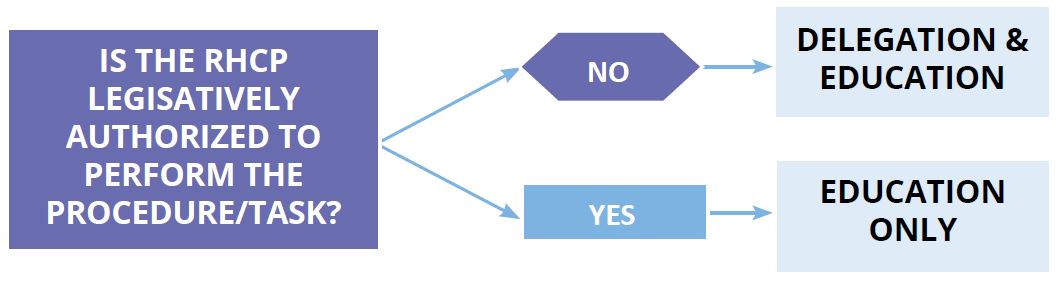
RTs work side-by-side a variety of other Regulated Health Care Professionals (RHCPs) and are often asked to share knowledge regarding a number of procedures with other members of the team. If a controlled act is involved, delegation is sometimes required but most often it is not. If a RHCP is “legislatively authorized”, it means they already have that particular controlled act authorized to them via their profession specific legislation (e.g., Nursing Act, Physiotherapy Act). What they may need, however, is education so that they gain the competency to perform the task effectively and safely. If asked to provide education to a RHCP, the RT should consider the following:

Example

RHCP who is not legislatively authorized
The administration of oxygen falls under the RHPA controlled act #5 “administering a substance by injection or inhalation”, which is a controlled act authorized to RTs. However, Speech Therapists are not currently authorized to administer oxygen and would require delegation. An RT can choose to delegate this controlled act to a Speech Therapist, or the delegation can come from another RCHP who is authorized to perform the procedure (e.g., physician). The RT may only be asked to provide the education in this scenario.

Critical Care Teams
Roles and responsibilities are often shared amongst team members of critical care transport teams and critical care response teams. Common team members include an RT, nurse and physician. Intubation and manual ventilation procedures may be performed as part of the work done by the team. Nurses and physicians have the legislative authority to perform these procedures and, therefore, do not require delegation. In practice however, some nurses or physicians may not be experienced in performing these activities and may require additional training. RTs have significant expertise in airway management and could provide the teaching required for these clinicians to become competent in performing these skills. In this situation it would be appropriate to teach these skills, ensuring that all general expectations of education are met.

4. Educating Respiratory Therapy Students

Expectations of RTs

Students often gain knowledge and attitudes about professionalism through role modelling. As a result, aside from theory and clinical practice, it is important that RT’s demonstrate a positive model of compassionate, respectful, and ethical care to all learners, and promote patient-centered care and collaborative relationships.

The characteristics of effective role modelling are as follows:

9

Self reflection

9

Clinical Excellence

9

Empathy

9

Communication

9

Availability

9

Demonstrated interest in teaching

9

Respect for others

9

Transparency

Expectations of Students in Respiratory Therapy Programs

The CRTO does not regulate respiratory therapy students as they are not (yet) Members of the CRTO. Section 9 of the RTA and the Registration regulation (O. Reg. 17/12) restricts the use of the term “Respiratory Therapist” (including variations and abbreviations such as RRT), in Ontario, to Members of the CRTO. However, the CRTO wishes to provide students in respiratory therapy programs the opportunity to identify themselves in a manner that reflects the training they are undertaking. For this reason, the CRTO allows respiratory therapy students to use the title “Student Respiratory Therapist” and SRT as a designation – provided that they are enrolled in an approved respiratory therapy program and only while functioning in the role of a student. In return, the CRTO expects Student Respiratory Therapist (SRTs) to:

9

clearly identify themselves by the title of “Student Respiratory Therapist” and the designation of SRT, ensuring informed consent is received from the patient, where applicable;

9

understand their role and responsibilities in the provision of care and be accountable for the quality of the care they provide;

9

understand and comply with the various laws that may affect their practice (e.g., RHPA, Health Care Consent Act);

9

maintain patient/client confidentiality;

9
ensure that all entries in a patient/client health record have been co-signed by their supervising RT when providing respiratory therapy under direct supervision;
9

communicate effectively with all members of the health care team they interact with;

9

know their limitations and only perform activities they are competent in and have adequate background preparation for; and

9

understand when and from whom to seek help.

For more information, please see the CRTO Registration and Use of Title PPG.

A student Respiratory Therapist is on summer break from school and is employed at a local hospital as an aide in the RT department. While acting in this role, the student is NOT permitted to introduce themselves as an SRT, as they are not functioning in the role of a student.​

Student Respiratory Therapists Performing Controlled Acts

The RHPA provides an exception permitting students to perform controlled acts provided they are “fulfilling the requirements to become a member of a health profession and the act is within the scope of practice of the profession and is done under the supervision or direction of a member of the profession”.

This means that Student Respiratory Therapists (SRTs) are permitted to perform controlled acts authorized to Respiratory Therapists – provided they do so while functioning as a student under the supervision or direction of a CRTO Member. The supervision or direction by a Member may be direct or indirect. For more information, please see the CRTO Supervision Policy and the CRTO Registration of Use of Title PPG.

Example… An SRT is going to intubate for the first time under the direct supervision of an RRT. The SRT is legislatively authorized to intubate (via the exception in the RHPA), and does not require delegation for this activity or any other controlled act authorized to RTs. However, the SRT needs education from the RRT in order to perform the task safely and competently. Both the SRT and RRT are accountable for their individual actions in this scenario. Documentation needs to reflect that the SRT was directly supervised and the supervising RRT must co-sign. For more information, please see the section on Shared Accountability when Educating at the end of this PPG.

Direct Supervision of SRTs and Documentation

Where an SRT is performing procedures under direct supervision, the supervising RRT and the SRT are expected to do the following:

9

document that the student has performed the procedure(s) under “direct supervision” in the patient/client’s health record;

9

provide complete documentation of the patient contact in the patient/client health record; and

9

ensure that the supervising RRT cosigns any entries made by a student in the patient/client record.

Remember that anyone reading the documentation must be able to clearly identify that the requirements of “direct supervision” have been met. Also, keep in mind that the student’s signature and that of the cosigning RT verifies the information provided and assures that the record of activity, assessment, behaviour, or procedure is both accurate and complete.

PLEASE NOTE:

GRTs must perform controlled acts authorized to RTs under General Supervision. This is due to the nature of their certificate of registration with the CRTO (i.e., temporary certificate with terms, conditions and limitations). Therefore, GRT’s are not permitted to supervise SRTs in the performance of any intervention that falls under a controlled act authorized to respiratory therapists (e.g., oxygen administration). GRT’s general supervision requirement does not require co-signing of documentation. For more information please see Registration and Use of Title PPG.​


Personal Relationships between Registered Respiratory Therapists and Student Respiratory Therapists

When RTs are involved in providing education to SRTs there is a power differential – whether directly as a faculty member/clinical instructor, or indirectly as a supervising staff RT. This power imbalance exists because the RRT has status and influence over the SRT, which may affect the success of the student. The CRTO strongly discourages personal relationships between CRTO members (who are directly or indirectly involved in the student’s education) and SRTs. In many circumstances such a personal relationship will amount to unprofessional conduct. A faculty member or clinical instructor will continue to have influence over a student until graduation, but a staff RT at a certain hospital or facility will likely only have influence as long as the student is on rotation in that environment. Once an influence over the student no longer exists, a CRTO member may form a relationship with their former student.

At all times, the RT must demonstrate professional behavior in their interactions with not only students, but colleagues, patients, and families. It is important that inappropriate or disruptive actions be avoided, including language, actions, and inactions that do not represent the professions expectations of the standards of practice.

For more information, please see the Abuse Prevention and Awareness PPG.

GLOSSARY

Authorized Act a controlled act, or portion of a controlled act, that is authorized within a health profession Act for a health professional to perform [there are five (5) acts authorized to Respiratory Therapists by the Respiratory Therapy Act, that are created from three (3) controlled acts defined in the RHPA]

Members is a respiratory therapist who is registered with the CRTO; including Graduate Respiratory Therapists (GRT), Practical (Limited) Respiratory Therapists (PRT) and Registered Respiratory Therapists (RRT).

REFERENCES
  1. College of Nurses of Ontario. (2002). Professional Standards. Retrieved from: https://www.cno.org/globalassets/docs/prac/41006_profstds.pdf
  2. College of Physicians and Surgeons of Ontario (2021) Professional Responsibilities in Medical Education. Retrieved from: https://www.cpso.on.ca/Physicians/Policies-Guidance/Policies/Professional-Responsibilities-in-Medical-Education
  3. Health.Vic (2020) The Best Practice Clinical Learning Environment (BPCLE) Framework (health.vic.gov.au). Retrieved from: https://www.health.vic.gov.au/education-and-training/best-practice-clinical-learning-environment-bpcle-framework

Additional Considerations

Shared Accountability When Educating


During the educational process, both the RT and learner are responsible for their own actions, while sharing accountability for the outcome of this knowledge exchange. The RT providing the education is responsible for determining whether it is appropriate to teach the particular procedure, as well as deciding how best to transfer the knowledge and evaluate the learner’s competence. Additionally, the RT is accountable to their patients/clients, their employer and to the CRTO. It is the learner’s responsibility to only engage in tasks they have the requisite competencies for, and are also often accountable to other entities (e.g., student RTs have accountability to their educational institution). RT’s must ensure that they are identified and available to assist learners when they are not being directly supervised (e.g. not in the same room). If necessary, RT’s must also ensure that an appropriate alternative supervisor is available and agreeable to assist.

Before permitting anyone (including a student) to perform an activity, it’s essential that the RT ensures they have assessed the potential harm associated with the procedure. They must also determine whether it’s appropriate to allow an individual to perform the activity after considering the individual’s existing competencies.

GLOSSARY

Authorized Act a controlled act, or portion of a controlled act, that is authorized within a health profession Act for a health professional to perform [there are five (5) acts authorized to Respiratory Therapists by the Respiratory Therapy Act, that are created from three (3) controlled acts defined in the RHPA]

Members is a respiratory therapist who is registered with the CRTO; including Graduate Respiratory Therapists (GRT), Practical (Limited) Respiratory Therapists (PRT) and Registered Respiratory Therapists (RRT).

REFERENCES
  1. College of Nurses of Ontario. (2002). Professional Standards. Retrieved from: https://www.cno.org/globalassets/docs/prac/41006_profstds.pdf
  2. College of Physicians and Surgeons of Ontario (2021) Professional Responsibilities in Medical Education. Retrieved from: https://www.cpso.on.ca/Physicians/Policies-Guidance/Policies/Professional-Responsibilities-in-Medical-Education
  3. Health.Vic (2020) The Best Practice Clinical Learning Environment (BPCLE) Framework (health.vic.gov.au). Retrieved from: https://www.health.vic.gov.au/education-and-training/best-practice-clinical-learning-environment-bpcle-framework